
Press Release
JAL Group Announces FY2008-2010 Medium Term Revival Plan
- FY2010 Operating Income Target Increased -
Tokyo February 29, 2008: The JAL Group today announced its Medium Term Revival Plan for FY2008-2010, the three fiscal years from April 1, 2008 to March 31, 2011. Building on corporate restructuring carried out over the past years, the JAL Group will continue focusing its energy and resources on the creation of a business foundation capable of stable growth and profit generation in any environment. The Group will gear itself up to take full advantage of the huge business opportunity presented by airport expansion in the Tokyo metropolitan area in 2010, which includes increases in slots at Haneda and Narita airports, and the internationalization of Haneda Airport.
The FY2008-2010 JAL Group Medium Term Plan continues and expands on the implementation of core elements outlined in previous corporate plans, whilst taking into consideration recent changes in the business environment such as the unabated rise in fuel prices; concerns of a fall in global demand resulting from the knock-effects of the sub-prime loan crisis; and fierce competition expected in the air transportation business both in Japan and abroad.
The airline group will continue fleet downsizing and renewal by replacing older aircraft with new mostly medium and small-size aircraft to increase competitiveness and reduce costs. To build a more profit-focused network, it will carry out further route restructuring by shifting to high profit, high growth routes and continue increasing the number of flights operated by low overheads airlines subsidiaries: JALways, JAL Express (JEX) and J-AIR. ‘Premium strategies’ aimed at wooing business and top-tier travelers through product and service enhancement and development will be expanded. Another key feature of the plan will be expanded group-wide cost reform, including increasing by 10% the productivity of the workforce a year ahead of schedule.
Following this pathway has already yielded positive results, as indicated by JAL Group’s upward revision of its forecast operating income for FY2007, the year ending March 31, 2008. The Group originally forecast a 35 billion yen income for FY2007, but this was increased to 48 billion yen when the results for the first half of the year were announced on November 6, 2007.
As a result of early successes in restructuring its business, the JAL Group in the FY2008-2010 revival plan has increased its operating income target for FY2010 to 96 billion yen up from the 88 billion yen target set in last year’s plan.
Furthermore, it was decided today at a JAL Corporation board meeting to issue to 14 companies approximately 150 billion yen of shares of preferred stock by means of a third-party allocation. The capital generated will be used to bolster the JAL Group’s business restructuring activities outlined in the Medium Term Revival Plan, helping to speed up, for example, fleet renewal and product and service quality enhancements.
The FY2008-2010 Medium Term Revival Plan focuses on the following 6 points:
1. Maintain flight safety
Following on from FY2007, the entire Group will continue nurturing a safety culture and strengthening its safety management systems to ensure that the highest levels of flight safety, the foundation and social responsibility of the JAL Group, are maintained at all times.
2. Improve Business Profitability
The JAL Group aims to increase profitability in all air transport business segments through fleet renewal and downsizing, matching supply better to demand whilst decreasing costs; concentrating resources on high growth high profit routes; increasing the operations of low overhead Group subsidiary airlines JALways, JAL Express and J-AIR; and employing ‘premium strategies’ targeted at business and top-tier travelers.
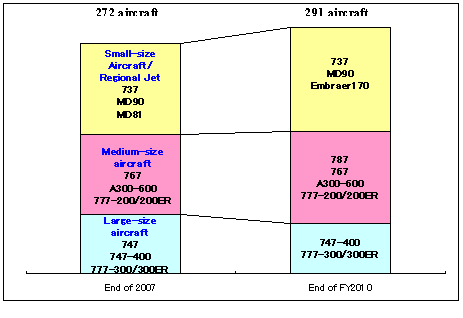
a) Fleet Strategy: Over the period of the plan, JAL will retire 46 aircraft from its fleet such as classic-type 747 and MD-81 aircraft, at the same time as introducing 65 more fuel-efficient, mainly small and medium-size aircraft to its fleet including the state-of-the-art Boeing 787 Dreamliner.
●Increase the percentage of more fuel-efficient aircraft in fleet : 777, 787, 737-800, Embraer 170l
・Domestic fleet* = 20% (end of FY07) >>> 41% (end of FY10)
* Not including HAC, JAC or RAC
●Continue fleet downsizing by expanding the percentage of medium and small size aircraft.
・303 seats per passenger flight (end of FY07) >>> 259 seats per flight (end of FY10)
・% of medium/ small size aircraft in domestic fleet = 91% (end of FY07) >>> 93% (end of FY10)
・191 seats per passenger flight (end of FY07) >>> 180 seats per flight (end of FY10)
Planned No. of Aircraft in JAL Group - FY2007 vs FY2010
b) Low Overheads Subsidiary Airline Strategy: JAL will expand the use on international and domestic routes of Group subsidiary airlines: JALways, JAL Express, J-AIR. These three subsidiary airlines offer the same level of service as JAL, but with approximately 10% lower overheads. JALways operates on international routes, primarily leisure and Asia business routes. JAL Express (JEX) currently serves domestic Japan routes, but in FY2009 will start operating 737-800 aircraft on international routes, primarily China. J-AIR operates CRJ regional jets in Japan and its operations will expand with the introduction of Embraer 170 to the JAL fleet in FY2008.
●International flights operated by JALways & JAL Express
・25% (end of FY07) >>> 38% (end of FY10)
●Domestic flights* operated by JAL Express and J-AIR
・25% (end of FY07) >>> 41% (end of FY10)
* Not including HAC, JAC, JTA or RAC.
c) Route Strategy: JAL will concentrate resources on high growth, high profit markets, adjust schedules and flight frequency to match demand and increase customer convenience whilst exploring opportunities in new markets where business demand is strong.
| ● | From Haneda Airport increase the number of international passenger short-haul routes, and increase the number of early-morning and late- night flight departures. |
| ● | Increase flight frequency from Narita Airport on routes business passenger demand is high such as those serving Asia including China, and Russia. |
| ● | Increase Asia routes and routes serving tourist destinations by using JALways, and international flights operated by JAL Express focusing on China. |
| ● | Explore new business development opportunities resulting from the introduction of the Boeing 787 to the international passenger fleet. |
| ● | Make improvements to the Japan domestic network by using small-size aircraft operated by JAL Express and J-AIR. |
| ● | Increase passenger convenience on Japan domestic routes by increasing frequency on select routes. |
| ● | Review scale and network of cargo business, using 767F on China and Southeast Asia routes and adjusting supply on transpacific routes. |
| ● | Assess opportunities for cargo business resulting from the establishment of 24 hour operations at Haneda in FY2010. |
d) Premium Strategies: Using effective sales channels, JAL aims to maximize revenue by employing premium strategies which appeal primarily to high yield business and top-tier travelers. Responding to customer feedback and changes in the market, the airline group will continue creating products and services of the highest quality.
| ● |
Introduce new first class and business class seats. ・Planned introduction of seats on US routes in FY2008. |
| ● |
Increase number of routes with JAL Premium Economy service. ・Already introduced on two Europe routes. To be introduced in FY2008 on US routes and other Europe routes |
| ● | Expand availability of JAL First Class service on Japan domestic flights. |
| ● | Continue improving lounges and check-in counter areas at Narita Airport. |
| ● | Improve services at airport facilities in overseas stations, such as lounge renovation at Honolulu, London, Paris and San Francisco. |
| ● | Promote e-business by improving IT systems for Japan domestic flights. |
| ● | Improve in Japan internet reservation functions, ticket less travel options such as JAL Touch & Go. |
3. Personnel Cost Reduction & Workforce Productivity Improvement
In FY2007, JAL initiated a bold review of its work content and work processes, work form, manpower allocation and restructuring of affiliated businesses. As this has progressed at a good pace, JAL expects to achieve its target of a 10% increase in the productivity of its workforce by the end of FY2008, one year earlier than originally expected.
As already announced, also a year earlier than was originally targeted in last year’s corporate plan, the company will also speed up the reduction of its workforce on a consolidated basis from 53,100 staff at the end of FY2006 to 48,800 staff by the end of FY2008.
JAL will continue to keep personnel costs down so that every financial year personnel costs are 50 billion yen lower than the level in FY2006.
4. Additional Personnel Cost Measures
Furthermore, by reviewing the wage system, JAL will continue to reduce personnel costs - the Group’s biggest fixed expense - resulting in a reduction in costs of 10 billion yen on a yearly basis.
5. Invest in Human Assets
The JAL Group will strengthen its operational processes and structure, building a system in which staff can develop a strong awareness of safety and customer opinion, and are able to acquire techniques and know-how through training.
6. Global Environmental Measures
For more than 15 years, the JAL Group has been implementing a variety of measures that are helping group-wide to reduce and offset the impact its business activities have on the environment. JAL will continue to fulfill its obligation to the environment and society. The JAL Group has been investing in more fuel-efficient aircraft and engines to reduce the CO2 emissions of its fleet; helping to monitor greenhouse gases in the upper atmosphere with specially developed air-sampling equipment fitted on aircraft; and has been conducting a wide range of recycling programs and air and noise pollution reduction measures, just to name a few of the environmental activities the Group has been involved in.
JAL Group Medium Term Revival Plan Consolidated Business Performance Targets FY08-10
|
Units (billions of yen) |
FY2008 |
FY2009 |
FY2010 |
|
Operating Revenue |
2,184.0 |
2,205.0 |
2,260.0 |
|
(International Passenger) |
807.0 |
815.0 |
853.0 |
|
(Domestic Passenger) |
704.0 |
730.0 |
736.0 |
|
(International Cargo) |
193.0 |
185.0 |
189.0 |
|
Operating Income |
50.0 |
75.0 |
96.0 |
|
Ordinary Income |
30.0 |
53.0 |
74.0 |
|
Net Income |
13.0 |
26.0 |
53.0 |
|
FY2008 |
FY2009 |
FY2010 |
|
|
EBITDA* |
172.0 |
198.0 |
220.0 |
|
Debt/ Equity Ratio |
1.7 |
1.4 |
1.1 |
|
ROE (%) |
2.8% |
5.1% |
9.8% |
*EBITDA = Earnings before interest, taxes, depreciation and amortization
FY2008-2010 Performance Target Assumptions
Percentage comparison with previous year
|
Available Seat Kilometers |
FY2008 |
FY2009 |
FY2010 |
|
International Passenger |
95.9% |
96.6% |
105.7% |
|
Domestic Passenger |
98.1% |
99.1% |
99.3% |
|
International Cargo |
90.6% |
90.5% |
101.5% |
|
FY2008 |
FY2009 |
FY2010 |
|
|
Fuel per barrel |
US$110/bbl |
US$110/bbl |
US$110/bbl |
|
Foreign Exchange Rate |
US$1 = \110 |
US$1 = \110 |
US$1 = \110 |
###
 MTCP08-10.pdf