


Press Release
JAL Group Unveils "JAL Group Management Vision 2035": A New Growth Strategy
―Driving Fundamental Business Portfolio Reform to Create Social Value and Achieve Sustainable Growth―
Summary
➢ Building a resilient business portfolio to drive social value creation and steady growth.
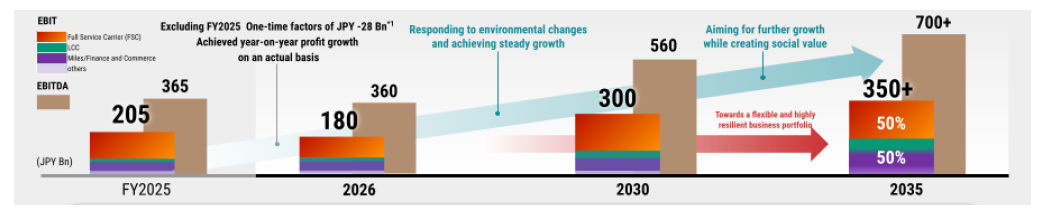
Aiming for a consolidated EBIT of 300 billion yen by FY2030 and over 350 billion yen by FY2035.
➢ Executing a strategic allocation of management resources exceeding 2 trillion yen over the next five years through accelerated fleet renewal, growth investment in new business domains, and technology investment aimed at productivity gains.
➢ Upwardly revising the consolidated full-year EBIT forecast to 205 billion yen for FY2026, alongside an increase in the annual dividend forecast from 92 yen to 96 yen per share.
Tokyo, JAPAN―The JAL Group today announced the formulation of its new growth strategy, the "JAL Group Management Vision 2035."
To effectively navigate the rapidly evolving business environment and ensure long-term sustainability, the JAL Group is transitioning from its traditional framework of "5-year management plans with annual rolling updates" to a more dynamic approach: a "10-Year Vision" coupled with "Agile Annual Plans." This shift enables the Group to pursue fundamental business transformations that require a long-term
perspective, while remaining flexible and responsive to immediate market changes through agile annual execution.
1. JAL Vision 2035: Defining our envisioned future
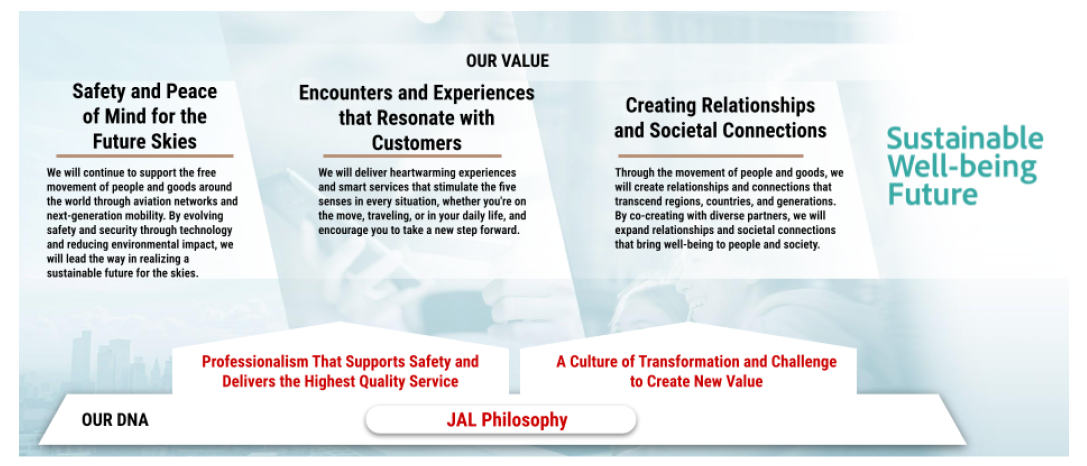
The JAL Group envisions a "Sustainable Well-being Future" -- a future where meaningful connections spread throughout society. In an era where technological advancement often coexists with social isolation, physical and psychological barriers will be bridged, enabling individuals to make diverse life choices and find fulfillment. By delivering value unique to the JAL Group, this sense of happiness is expected to expand across society.
2. Transforming into a Resilient Business Portfolio
To transform into a business portfolio resilient to external environmental changes and to realize social value creation with steady growth, fundamental structural reforms will be undertaken along three axes:
Growth: Firmly capturing business growth opportunities.
Sustainability: Adapting flexibly to environmental changes and risks to enhance the sustainability of aviation infrastructure.
Social Impact: Expanding business domains starting from social value.
Through these transformations, the Group targets a consolidated EBIT of 300 billion yen by FY2030 and 350 billion yen by FY2035.
◎ Growth
➢ Expanding international ASK (Available Seat Kilometers) by 1.3 times in FY2030 compared to FY2025. Growth will be driven by both Full-Service Carriers (FSC) and Low-Cost Carriers (LCC).
➢ Expanding supply of large freighters to meet robust cargo demand between Asia, North America, and Europe.
➢ Achieving rapid growth in the Mileage & Lifestyle business through strategic Investments of over 80 billion yen over the next five years and global partnership expansion.
(International Route Business)
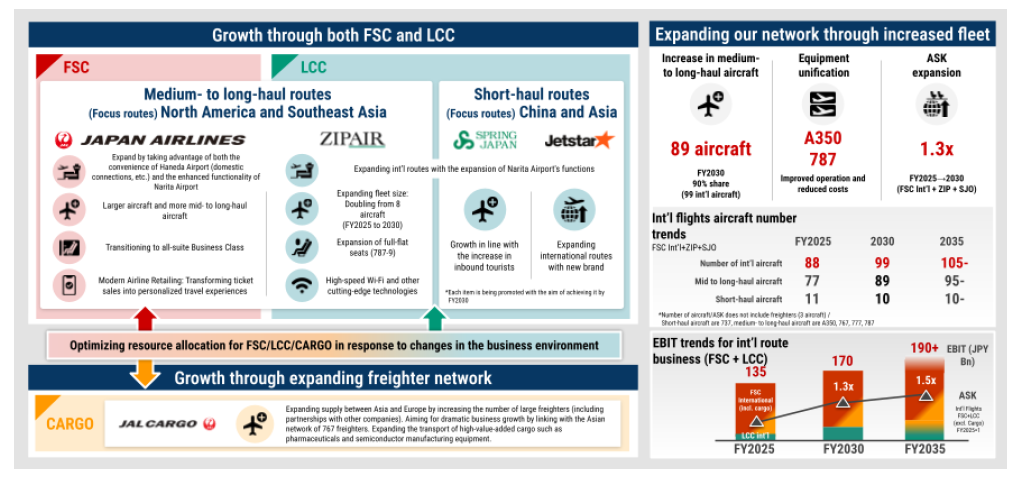
Capacity will be expanded by introducing larger aircraft in the Full-Service Carrier (FSC) fleet, with a strategic focus on strengthening medium- and long-haul routes. Growth will be accelerated alongside the expansion of the LCC business centered on ZIPAIR.
By FY2030, international ASK (FSC and LCC combined) is expected to increase by 1.3 times compared to FY2025. Leveraging the convenience of Haneda Airport and the enhanced functionality of Narita Airport, inbound and other passenger demand growth will be effectively captured.
On short-haul routes, contributions will be made by capturing inbound demand and promoting regional travel through SPRING JAPAN and Jetstar Japan, the latter currently undergoing a brand refresh following a strategic shareholder change.
In the Cargo and Mail business, supply will be expanded with large freighters to meet robust demand between Asia, North America, and Europe. Profitability will be maximized by strengthening the transport of high-value-added cargo such as pharmaceuticals and semiconductor manufacturing equipment.
By flexibly optimizing resource allocation between passenger and cargo operations in response to environment changes, market growth will be reliably captured, enabling resilient business expansion.
(Mileage & Lifestyle Business)
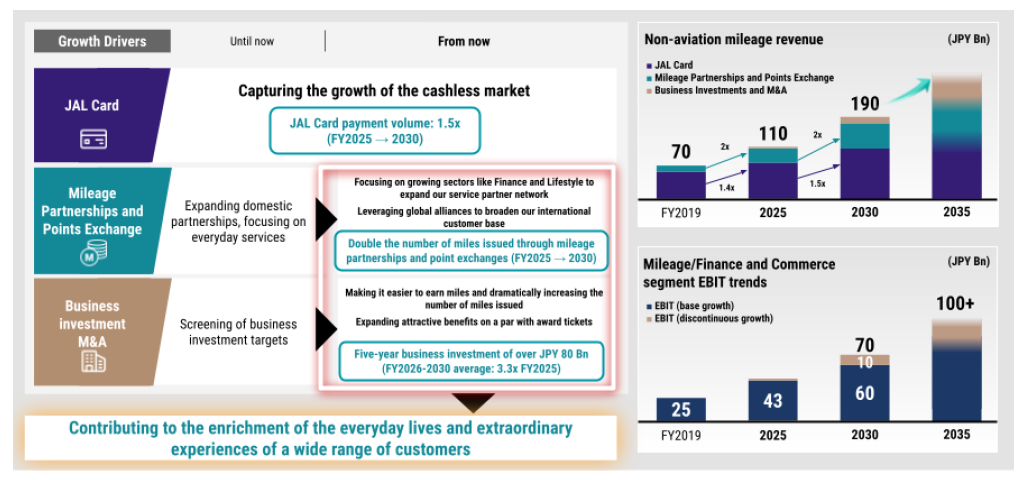
Mileage & Lifestyle business is expected to achieve significant growth by leveraging the strengths of the JAL Card and expanding mileage and point exchange partnerships, which have been key growth drivers to date. Furthermore, global partnership expansion and proactive business investments will drive a dramatic increase in mileage issuance in the non-aviation domain, leading to overall business growth. Business investments will also focus on enhancing rewards, especially those that allow redemption for award tickets, thereby increasing the attractiveness of mileage.
By FY2030, the EBIT for Mileage & Lifestyle business is targeted to reach 70 billion yen, representing an increase of more than 1.6 times over FY2025 levels.
To achieve this breakthrough growth, strategic investments exceeding 80 billion yen will be implemented over the five-year period starting in FY2026.
◎ Sustainability
➢ Structural reforms will be implemented in the domestic route business to achieve a profit margin of 10% and an EBIT of 60 billion yen in FY2028.
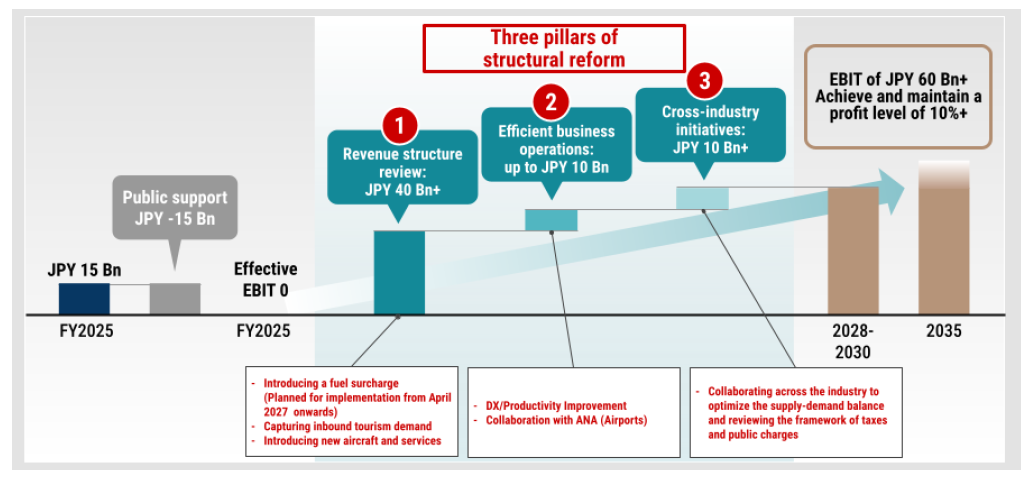
In domestic operations, radical structural reforms will be implemented to enhance profitability in response to structural cost increases driven by foreign exchange fluctuations and rising prices.
To overhaul the revenue structure and address rising fuel costs, the introduction of a fuel surcharge on domestic flights is under consideration starting in April 2027. Efforts to intensify the attraction of robust inbound demand to the domestic network are also planned. On the operational side, rigorous cost containment will be pursued through digital transformation, service simplification, and expansion of industry-wide collaboration. This includes broadening initiatives such as the shared use of specialized airport ground support equipment (GSE) and coordination of passenger handling services, building on successful implementations at select regional airports. Furthermore, industry-wide discussions will be accelerated to optimize the supply-demand balance of routes and flight frequencies.
Through these multifaceted initiatives, the establishment of a stable earnings base with a target EBIT of 60 billion yen and an operating margin of 10% or higher is expected by FY2028, ensuring the sustainability of the domestic network as a vital piece of social infrastructure.
◎ Social Impact
➢ Through co-creation involving the JAL Group's extensive assets and strategic partners, business growth will be driven while generating meaningful social impact for corporations and regional communities.
➢ At the center of this vision is the "AMOP®" platform, which serves as the core for pioneering new business opportunities in next-generation mobility, including drones and "flying cars" (eVTOL).
*AMOP®(Air Mobility Operation Platform)
A proprietary platform unique to JAL that digitally integrates and optimizes the safe operation of drones and business of drones and flying cars. Leveraging aviation expertise, it serves as a core system to firmly establish next-generation mobility as social infrastructure.
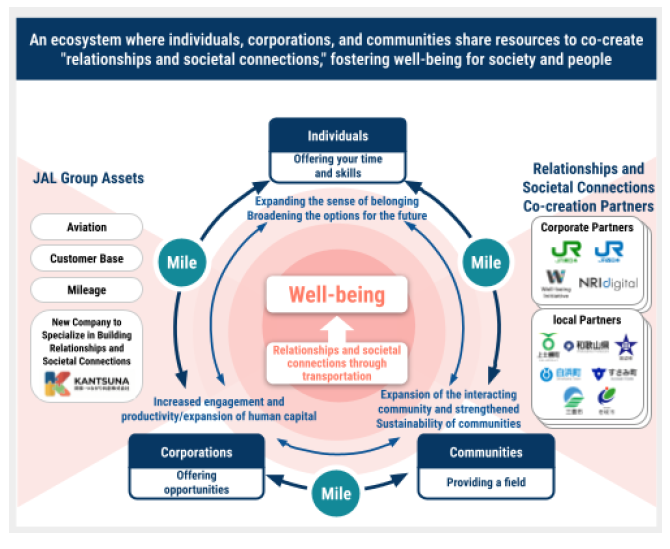
The JAL Group is dedicated to building an ecosystem that fosters a cycle of well-being for society and individuals. By co-creating "Relationships and Societal Connections," the aim is to expand people's horizons and provide diverse options for a more fulfilling life. By 2035, with business profits exceeding 6 billion yen, the JAL Group will actively pursue the creation of social impact, including "improving individual well-being," "enhancing corporate productivity and engagement," and "increasing regional related population and local consumption."
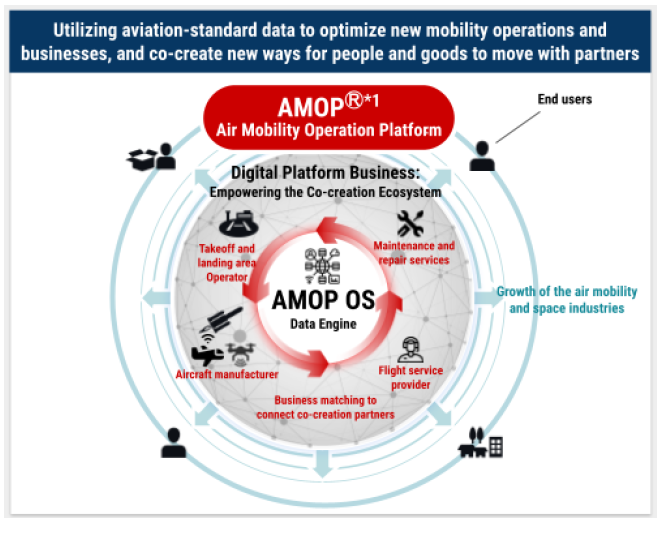
Social infrastructure will be built through "AMOP®," a platform designed to co-create the mobility of people and goods in collaboration with diverse stakeholders involved in next-generation mobility, including drones and "flying cars" (eVTOL). In the Next-Generation Mobility domain, the challenge of generating 5 billion yen in profit by FY2035 is being actively pursued.
4. Company-wide Strategy (CX, GX, Human Resources / DX, Safety)
◎ CX (Customer Experience)
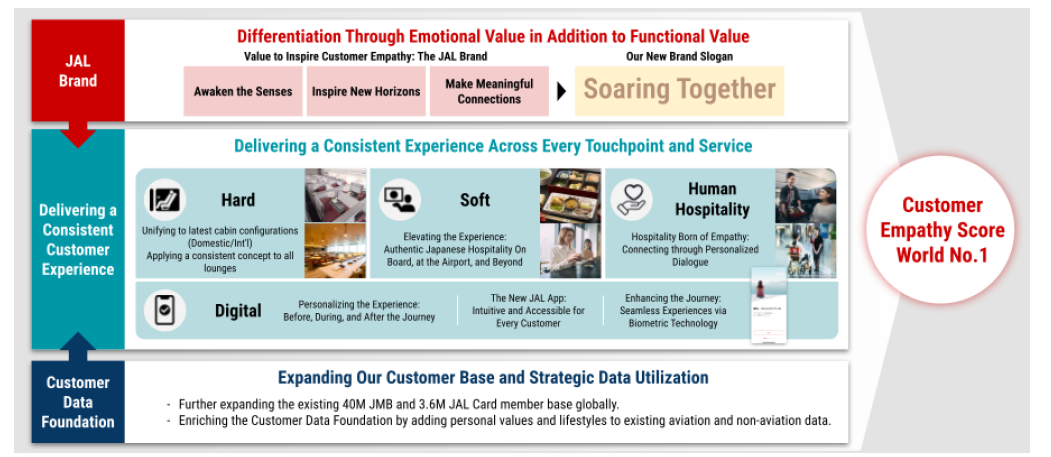
Guided by the new brand slogan, "Soaring Together," the JAL Group seeks to strengthen its relationship with customers by delivering a consistent, high-quality experience across all services. The goal is to become the world's No. 1 airline in "Customer Empathy" by building deep, long-term relationships centered on "empathy" with customers.
Press Release Dated March 02, 2026: New Brand Slogan: "Soaring Together"
◎ GX (Green Transformation)
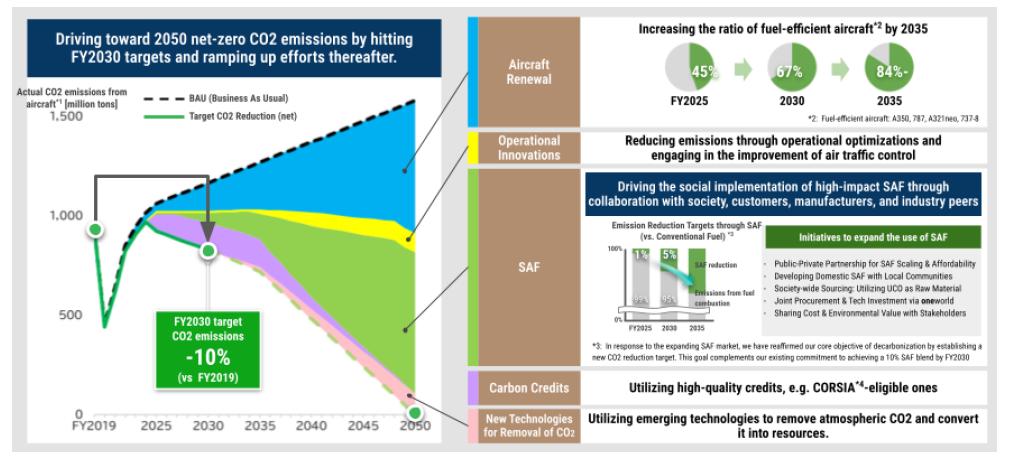
To achieve Net-Zero CO2 emissions by 2050, the JAL Group is committed to steadily reaching the interim target of a 10% reduction in emissions by FY2030 (compared to FY2019 levels). Public-private partnerships will be strengthened to scale up the production and improve the affordability of domestically produced SAF (Sustainable Aviation Fuel), demonstrating the JAL Group's sincere dedication to a sustainable future for aviation.
◎ DX (Digital Transformation)
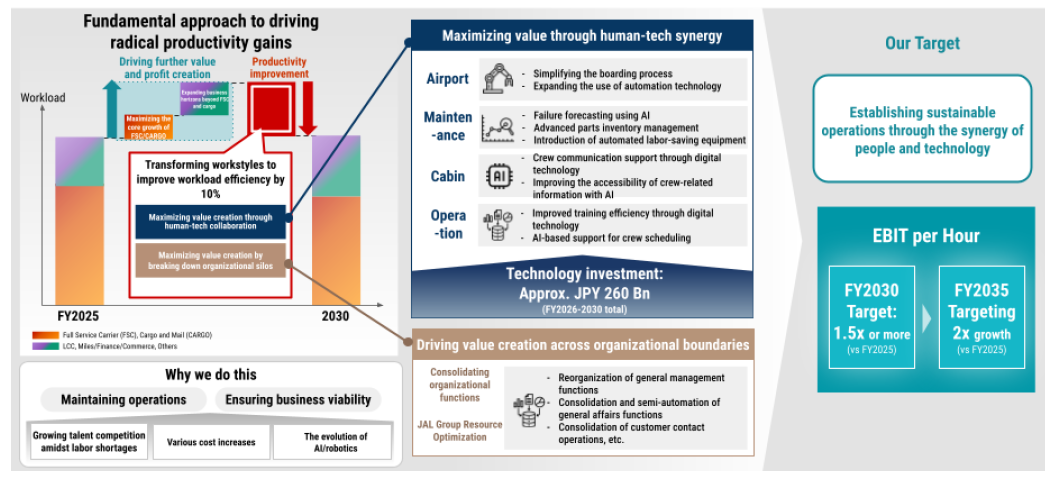
To ensure sustainable operations and establish a resilient operational framework amidst a shrinking working-age population and structural cost increases, a technology investment of approximately 260 billion yen will be executed over the five-year period from FY2026 to FY2030. By actively integrating AI and digital technologies, operational efficiency will be improved while combining the unique strengths of JAL Group's talent with data-driven insights to foster innovation.
Simultaneously, Human Capital Management rooted in the well-being of every employee will be advanced, maintaining an annual human capital investment of approximately 80 billion yen. By synergizing the use of "Human-centric technology" with the cultivation of "an environment where employees can thrive," the aim is to increase hourly productivity by 1.5 times by FY2030 and more than double it by FY2035.
◎ Safety
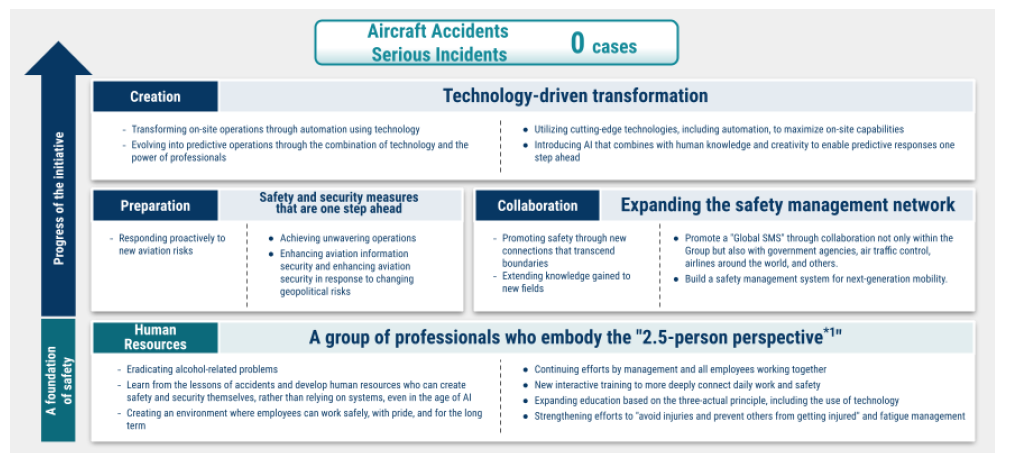
Safety is the cornerstone of the JAL Group's foundation and the basis of all activities. By integrating advanced technology with professionalism, the pursuit of world-class safety quality continues without compromise. The commitment to maintaining the record of zero aircraft accidents and serious incidents remain unchanged, providing unwavering safety even in an ever-changing environment.
5. Financial Strategy, Management Targets. Strategic Allocation of Management Resources
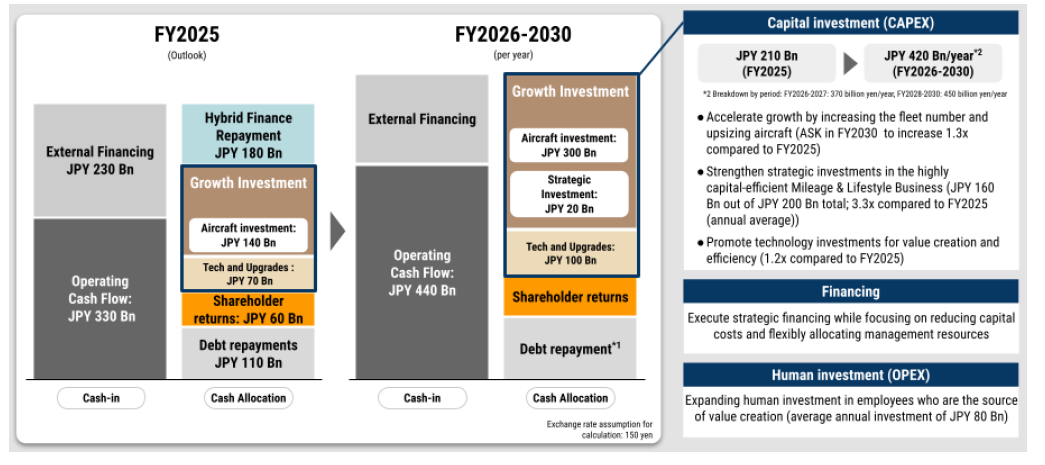
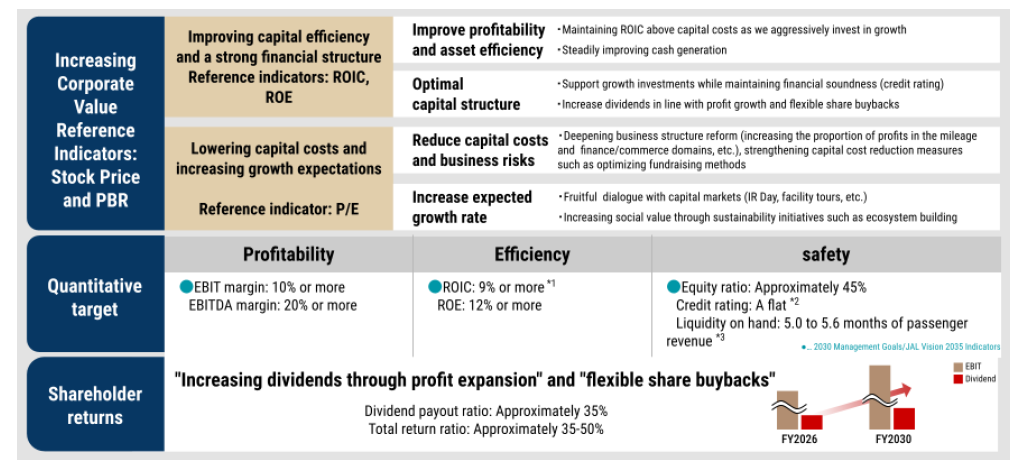
While aiming for an EBIT margin of 10% or more and an ROIC of 9% or more, the JAL Group will maintain an equity ratio of approximately 45% to balance a strong financial position and high capital efficiency. The dividend payout ratio is targeted at around 35%, and the total return ratio is set between approximately 35% and 50%. Shareholder returns will be strengthened through increasing dividends through profit expansion, combined with flexible share buybacks.
Moreover, bold investments will be made in growth areas to achieve sustainable increases in corporate value. Specifically, average annual investments of around 400 billion yen will be made, including fleet expansion for international routes, investments in non-aviation domains, and technology investments, accelerating future growth.
6. Consolidated Financial Forecast and Dividend Forecast
The full-year consolidated EBIT for the fiscal year ending March 2026 is forecasted at 205 billion yen, exceeding the initial expectations. Corresponding to the upward revision of the financial forecast, the annual dividend forecast for the fiscal year ending March 2026 will be raised from 92 yen to 96 yen per share.
The full-year consolidated EBIT for the fiscal year ending March 2027 is forecasted at 180 billion yen; however, excluding the impact of special factors in FY2025, the underlying profit is expected to grow. The annual dividend forecast for fiscal 2027 is 96 yen per share, including an interim dividend forecast of 48 yen per share.
As the first year of transformation towards achieving the FY2030 targets, the investment effects will be steadily linked to profit growth.