


Press Release
JAL Group Announces Consolidated Financial Results for the First Half of Fiscal Year Ending March 2027
Summary
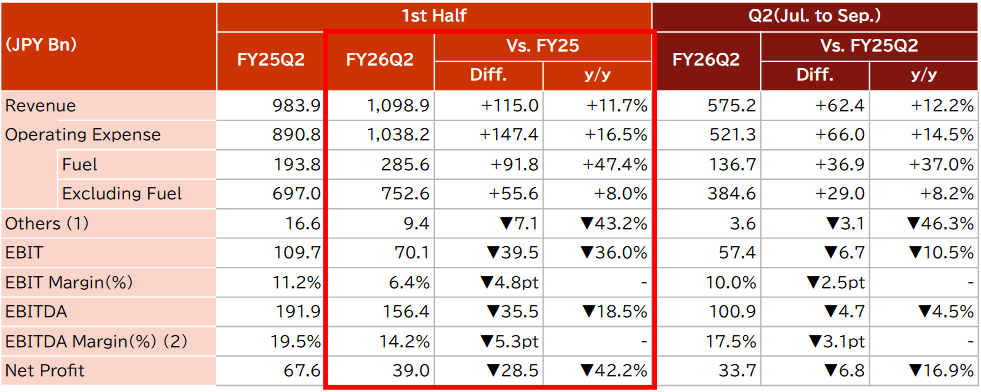
- Revenue for both aviation business and the Mileage/Finance and Commerce Business exceeded the previous year’s levels, reaching JPY 1,098.9 billion (up 11.7% year-on-year), achieving record-high revenue since the company’s re-listing for both the first-half cumulative period and the second quarter alone.
- For EBIT, a consolidated profit of JPY 70.1 billion (down 36.0% year-on-year) was achieved despite strong headwinds such as surging fuel prices and persistent yen depreciation, supported by the strong profitability of international passenger flights and contributions from a diversified revenue base in non-aviation business. Recovering from the first-quarter shortfall against the plan, first-half cumulative EBIT rebounded to a level exceeding the initial forecast.
- For this fiscal year, the target EBIT of JPY 180.0 billion and net profit of JPY 110.0 billion, and annual dividend forecast of JPY 96 per share remain unchanged. The interim dividend has been set at JPY 48 per share.
Tokyo, JAPAN - The JAL Group today announced its consolidated financial results for the first half of fiscal year ending March 2027 (April 1, 2026 - September 30, 2026).
1. JAL Group Consolidated Financial Results
For the first half, the JAL Group achieved a record-high revenue since re-listing of 1,098.9 billion yen (up 11.7% year-on-year), driven by agile pricing strategies that captured robust demand in international passenger flights and cargo, as well as unit price improvements in domestic passenger flights. Surging fuel prices and the persistent depreciation of the yen led to a sharp increase in fuel expenses, increasing operating expenses by 16.5% year-on-year to 1,038.2 billion yen. As a result, EBIT was 70.1 billion yen (down 36.0% year-on-year), and net profit was 39.0 billion yen (down 42.2% year-on-year).
(1) Others = Gain on Sales of Aircraft, Other Income, Share of Profit or Loss of Investment and Income/Expenses from Investment
(2) EBITDA Margin = EBITDA/Revenue EBITDA = EBIT + Depreciation and Amortization
2. Performance by Business Segment
For the Full service Carrier and LCC businesses, sharp rises in fuel costs led to an increase in revenue and a decline in profit year-on-year. For the Mileage/Finance and Commerce Business, strong mileage issuance revenue led to an increase in both revenue and profit.

Note: Revenue and EBIT in each business segment are figures before intersegment eliminations
Full Service Carrier Business
Although sharp rises in fuel costs resulted in an EBIT decline of 45.3% year-on-year to 41.6 billion yen, unit price improvements for both international and domestic passenger flights through agile revenue management, along with capturing cargo demand through the expansion of the freighter network, contributed to a revenue growth of 14.2% year-on-year to 884.9 billion yen.
■ International Passenger
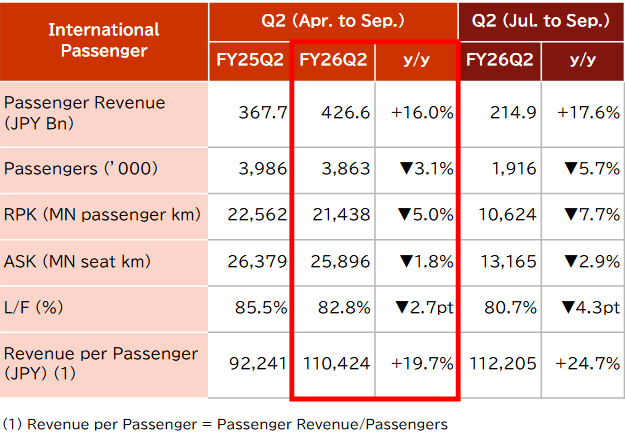
Alongside surging fuel prices, an increase in fuel surcharge revenue, coupled with agile revenue management, contributed to a sharp increase in unit price.
As a result, although passenger numbers declined by 3.1% year-on-year, passenger revenue grew by 16.0% year-on-year.
■ Domestic Passenger
Revenue management capturing high-demand periods achieved an 8.2% year-on-year increase in unit price.
As a result, although passenger numbers declined by 2.2% year-on-year, passenger revenue grew by 5.8% year-on-year.

■ Cargo and Mail
For international cargo, effectively utilizing the freighter network to capture robust demand originating in Asia bound for North America--predominantly in AI-related sectors--resulted in a significant revenue increase of 46.8% year-on-year.
Domestic cargo revenue increased by 6.3% year-on-year, driven by proactive efforts to acquire new customers.

LCC Business
Reflecting growing demand in the LCC market, revenue increased by 11.4% year-on-year to 65.8 billion yen, while EBIT declined by 73.0% year-on-year to 1.8 billion yen due to sharp rises in fuel costs.
■ ZIPAIR
The enhancement of product value through the completed installation of "Starlink", high-speed internet service across all aircraft, and flexible pricing strategies responding to the market, led to a 12.3% increase in passenger revenue year-on-year.

■ SPRING JAPAN
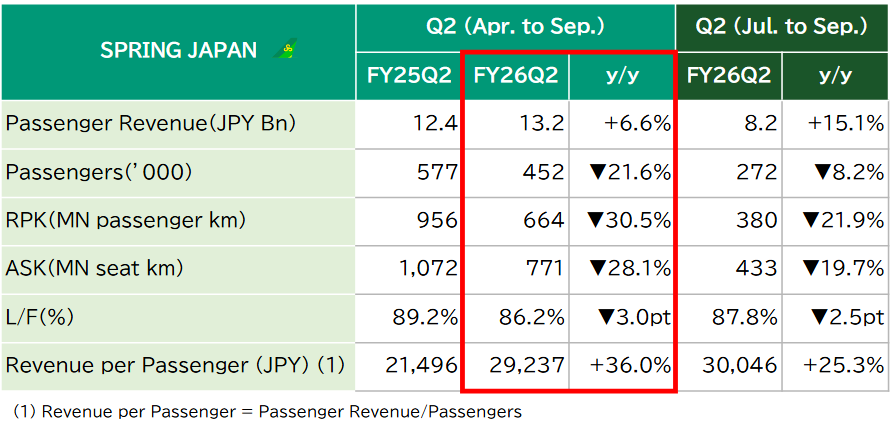
Capturing tightened supply-demand conditions caused by capacity reductions, primarily on routes such as Beijing and Shanghai (Pudong), resulted in revenue growth of 6.6% year-on-year and a significant increase in unit price per passenger.
Mileage/Finance and Commerce Business
Expanding mileage issuance in the non-aviation domain through growth in JAL Card transaction volume and enhanced global alliances with overseas financial institutions, combined with stimulating mileage circulation through diversified redemption options, led to revenue growth of 12.7% year-on-year to 121.6 billion yen and EBIT growth of 5.4% year-on-year to 22.2 billion yen, maintaining stable profit growth.

Other
A decline in contracted ground handling flights resulting from flight reductions by overseas airlines in East Asia and the Middle East led to a 7.1% decline in revenue to 118.8 billion yen, and an EBIT decline of 13.7% year-on-year to 5.5 billion yen.
3. JAL Group Consolidated Financial Position and Cash Flow

4. Forecast of Consolidated Financial Results and Dividend for Fiscal Year Ending March 2027
The full-year consolidated financial forecast for the fiscal year ending March 2027 remains unchanged from the forecast announced in the "Consolidated Financial Results for the Year Ended March 31, 2026" dated April 30, 2026. The forecast includes consolidated revenue of JPY 2,095.0 billion, EBIT of JPY 180.0 billion, and net profit of JPY 110.0 billion. The annual dividend forecast also remains unchanged at JPY 96 per share, of which the interim dividend has been determined at JPY 48 per share.
5. Recent Initiatives
Full Service Carrier Business
➢ To replace the regional Embraer E170/E190 fleet operated by J-AIR, which connects regions across Japan based at Osaka International Airport (Itami), the decision was made to introduce Embraer E190-E2 aircraft. A total of 26 aircraft (16 firm orders and 10 options) have been ordered, with introduction scheduled to begin in fiscal year 2029.
➢ On September 3, 2026, a Memorandum of Understanding on a Strategic Partnership was signed with Korean Air, followed by a Joint Declaration. Elevating the strong cooperative system cultivated between the two airlines over more than 60 years to the next level, the JAL Group and Korean Air will co-create new value and customer experiences in Asian and global markets originating from Japan and South Korea.

➢ Starting in the second half of fiscal year 2026, flight frequencies on the Naha-Taipei (Taoyuan) route operated by JTA will be increased to two daily flights by adding an evening schedule. This initiative will expand customer options and contribute to attracting further inbound visitors to Okinawa.
➢ In addition to launching a new Osaka (Itami)-Obihiro route in December 2026, the Osaka (Itami)-Asahikawa and Memanbetsu routes--previously operated only during the summer season--will operate year-round starting in the second half of fiscal year 2026. This network reinforcement between Osaka and Hokkaido (Doto and Dohoku regions) will enhance customer convenience.
➢ On October 8, 2026, the domestic lounges in the North Wing of Haneda Airport Terminal 1 reopened following a comprehensive renewal. The lounges have been transformed into dynamic spaces tailored to the varied needs and preferences of diverse customers, including business travelers, leisure travelers, and inbound travelers. Furthermore, seating capacity in the JAL First Class Lounge was expanded by approximately 1.4 times compared to previous levels, ensuring an exceptional environment of comfort.

LCC Business
➢ ZIPAIR launched flights on the Narita-Kuala Lumpur route in October 2026. In addition, the airline operated three round-trip direct charter flights between Narita and Orlando in August 2026, actively driving the capture of new demand in the North American market.
➢ SPRING JAPAN announced a comprehensive brand renewal on October 26, 2026. Toward future business expansion, the airline continues to evolve across all dimensions to deliver the distinct appeal of SPRING JAPAN to an expanding customer base. The first aircraft featuring the new livery is scheduled to enter service by the end of 2026.

Mileage/Finance and Commerce Business and Other
➢ New services for JAL Mileage Bank (JMB) members will be launched across "FHG HOTELS." In addition to earning miles on hotel stays, members will be able to redeem miles through "JAL Mile de Taiken" for coupons that can be applied directly toward accommodation costs.

Cargo Business
➢ On October 3, 2026, a cargo transportation partnership covering intra-Asia and North America-Asia routes was launched with NIPPON EXPRESS HOLDINGS, INC. Utilizing a Boeing 747 freighter secured by JAL through cooperation with its partners, the JAL Group will effectively address expanding cargo demand.

New Businesses
➢ In collaboration with Donecle, a French manufacturer specializing in aircraft maintenance drones, verification began for Japan's first visual aircraft exterior inspections utilizing fully autonomous drones approved in aircraft manufacturer's maintenance manuals. By replacing conventional visual inspections involving working at heights by maintenance personnel with autonomous drones, this initiative aims not only to substantially reduce inspection time and enhance the safety of maintenance work, but also to further elevate aircraft quality.
Sustainability
➢ The JAL Group will participate as a "Gold Partner" sponsor in GREEN×EXPO 2027, scheduled for March 2027. In alignment with creating a "sustainable society in harmony with nature" as targeted by GREEN×EXPO 2027 and the realization of "JAL Group Management Vision 2035," the JAL Group will co-create each individual's "small actions."

➢ Toward the introduction and advancement of negative emissions technologies that directly capture and remove CO2, Japan's first demonstration testing for Direct Ocean Capture (DOC) will be conducted on Kume Island, Okinawa Prefecture, in collaboration with Hitachi, Ltd. and Mitsui O.S.K. Lines, Ltd. Furthermore, the JAL Group concluded the world's first purchase agreement with Swiss startup Climeworks Solutions for CORSIA-compliant carbon dioxide removal (CDR) credits derived from Direct Air Capture (DAC). Through a multifaceted carbon removal approach covering both ocean and atmosphere, the JAL Group aims to realize a decarbonized society and contribute to the blue economy.